
In a healthcare environment shaped by digital-first patient behavior, marketing performance can no longer be evaluated through visibility alone. Hospitals, specialty clinics, and private practices must connect outreach efforts to measurable outcomes such as patient acquisition, engagement quality, and long-term retention. To measure success in healthcare marketing, organizations need a structured framework that aligns marketing metrics with patient intent, regulatory requirements, and clinical service goals. This goes beyond tracking traffic or impressions. It requires understanding how each interaction influences patient trust, decision-making, and appointment conversion. Today, many practices are turning to professional healthcare marketing services to drive visibility. By combining industry expertise with advanced SEO strategies, these services help practices rank higher, attract patients, and build trust online.
A clear distinction exists between organizations that generate visibility and those that convert that visibility into patient growth. High-performing healthcare providers do not track metrics in isolation. They connect data points across the patient journey, from initial search behavior to post-treatment engagement. This integrated perspective enables more accurate performance evaluation and supports continuous optimization.
Why Metrics in Healthcare Marketing Require a Different Approach
Healthcare marketing operates under conditions that differ significantly from other industries. Patients do not behave like typical consumers. Their decisions are influenced by urgency, perceived risk, trust in providers, and clarity of information.
For example:
- A patient searching for “emergency care near me” expects immediate, location-based results and fast access to contact options
- A patient researching elective procedures such as cosmetic treatments may spend weeks evaluating providers, reading reviews, and comparing outcomes
These differences affect how metrics should be interpreted. A high bounce rate on an emergency services page may not indicate poor performance. It may reflect quick access to contact information. In contrast, a high bounce rate on a treatment explanation page may signal insufficient detail or unclear messaging.
This context-driven interpretation is essential. Metrics without context can lead to incorrect conclusions and ineffective optimization.
Refine your online campaigns with data-driven decisions by using our expert digital marketing services!
Patient Acquisition Metrics
To effectively measure success in healthcare marketing, organizations must track a combination of acquisition, engagement, conversion, and retention metrics. These indicators work together to provide a complete view of patient behavior, campaign performance, and long-term growth. Rather than evaluating isolated data points, healthcare marketers need a connected framework that aligns each metric with patient intent and business outcomes.
Cost Per Acquisition (CPA)
CPA reflects how efficiently marketing spend converts into new patients. However, in healthcare, CPA must be evaluated alongside patient value.
For instance:
- A low CPA for general consultations may appear efficient
- A higher CPA for specialized procedures may still be profitable due to higher revenue per patient
Without this context, CPA alone can be misleading.
New Patient Volume with Service Segmentation
Tracking total new patients is insufficient. Organizations should segment acquisition data by service lines such as cardiology, dermatology, or orthopedics.
This reveals:
- Which services respond best to marketing efforts
- Where additional investment is justified
- Which campaigns require adjustment
Source Attribution Across Channels
Healthcare journeys are rarely linear. A patient may discover a provider through search, revisit through direct traffic, and convert after reading reviews.
Effective attribution models must account for:
- Multi-touch interactions
- Offline conversions such as phone bookings
- Referral and physician networks
Digital Engagement Metrics with Context
Engagement metrics provide insight into how patients interact with digital platforms, but they require careful interpretation.
Time on Page with Intent Analysis
Long session duration indicates engagement, but its meaning depends on page type.
- On educational pages, longer duration reflects interest and information consumption
- On appointment pages, shorter duration may indicate efficient conversion
Bounce Rate by Page Purpose
Instead of treating bounce rate as a negative signal, organizations should evaluate it based on intent.
- High bounce on contact pages may indicate successful user action
- High bounce on service pages may indicate weak content depth
Pages per Session and Journey Depth
This metric reflects how extensively users explore the site. In healthcare, deeper navigation often correlates with higher intent, particularly for elective procedures.
HubSpot defines click-through rate as a measure of user interaction, while conversion rate reflects how effectively those interactions result in desired actions.
Conversion Metrics That Reflect Real Outcomes
Conversion metrics must align with actual patient actions rather than surface-level interactions.
Appointment Booking Rate by Channel
Tracking bookings without channel segmentation limits insight. Organizations should analyze conversion rates across:
- Organic search
- Paid campaigns
- Referral traffic
This identifies which channels generate high-intent patients.
Call Conversion Quality
Not all calls indicate success. Healthcare providers should assess:
- Call duration
- Inquiry relevance
- Appointment confirmation rate
This ensures that marketing efforts attract qualified patients.
Form Submission Intent
Forms should be evaluated based on quality, not just volume. A smaller number of high-intent submissions is more valuable than a large number of low-quality inquiries.
Data from Pew Research Center shows that most health-related searches begin on search engines and frequently influence decisions such as consulting a doctor or seeking further care.
Search Visibility Metrics That Drive Patient Acquisition
Search visibility remains a primary driver of patient discovery, particularly for local and condition-based searches.
Organic Traffic by Service Line
Instead of tracking overall traffic, organizations should evaluate traffic by specialty. This reveals which services benefit most from search visibility.
Keyword Positioning for High-Intent Queries
Ranking for informational keywords is valuable, but high-intent queries such as “specialist near me” or “treatment options for [condition]” drive conversions.
Click-Through Rate Optimization
CTR reflects how effectively search listings match user expectations. Improving titles and descriptions can significantly increase patient acquisition without additional spend.
Many providers partner with a healthcare SEO agency to refine these metrics and improve competitive positioning.
Patient Retention and Lifetime Value
Healthcare marketing does not end with acquisition. Retention metrics provide insight into long-term success.
Patient Retention Rate by Service Type
Retention varies across services. Chronic care patients may return regularly, while one-time procedures may not.
Segmenting retention data helps organizations understand:
- Patient loyalty patterns
- Opportunities for follow-up care
- Cross-service engagement potential
Lifetime Value (LTV) with Clinical Context
LTV must consider treatment frequency, service type, and patient needs. This metric helps justify marketing investment and prioritize high-value services.
Patient Experience and Review Signals
Online reviews and satisfaction scores influence both retention and acquisition. Strong ratings improve trust and visibility.
The Impact of AI on Healthcare Marketing Measurement
AI-driven systems are reshaping how healthcare organizations analyze performance and optimize strategies. Traditional reporting methods rely on static dashboards and delayed insights. AI-enabled systems introduce real-time analysis and predictive capabilities.
AI-Assisted Behavioral Analysis
AI-assisted tools analyze user behavior across multiple touchpoints. They identify patterns that indicate patient intent, such as repeated visits to treatment pages or interaction with contact elements.
AI-Driven Predictive Modeling
Predictive analytics forecasts patient demand based on historical trends. This helps organizations:
- Anticipate seasonal variations
- Allocate marketing budgets more effectively
- Identify high-performing channels before trends become obvious
AI-Enabled Personalization
AI-enabled systems tailor messaging based on user behavior, location, and search patterns. This improves engagement and increases conversion probability.
AI-Driven Attribution Models
Traditional attribution models often fail to capture the complexity of healthcare journeys. AI-driven models evaluate multiple interactions to determine the true impact of each channel.
A McKinsey report notes that a majority of organizations report AI-related revenue increases across business functions, including marketing and sales. This highlights the growing role of AI-driven systems in improving performance across healthcare marketing initiatives.
Operational Challenges in Measurement
Even with advanced tools, healthcare organizations face structural challenges.
- Fragmented data across systems such as CRM, EHR, and marketing platforms
- Regulatory constraints affecting data tracking and personalization
- Difficulty linking online interactions with offline patient visits
- Complexity in multi-channel attribution
Addressing these challenges requires integrated systems, standardized reporting frameworks, and clear governance.
How High-Performing Organizations Act on Metrics
The difference between average and high-performing healthcare marketers lies in how they use data.
Effective organizations:
- Define performance thresholds for each metric
- Identify early warning signals such as declining conversion rates
- Prioritize metrics based on business impact rather than volume
- Continuously refine campaigns based on real-time insights
For example, a drop in appointment conversion rate may trigger:
- Review of landing page clarity
- Adjustment of call-to-action placement
- Analysis of traffic quality
This action-oriented approach ensures that metrics drive decisions rather than passive reporting.
The Role of Specialized Expertise
Healthcare marketing requires domain knowledge, regulatory awareness, and technical capability. Many organizations rely on providers offering healthcare marketing services to manage complex campaigns and performance frameworks.
Similarly, healthcare SEO services play a critical role in improving search visibility and attracting high-intent patients through targeted optimization.
These partnerships enable organizations to maintain high standards while focusing on clinical delivery.
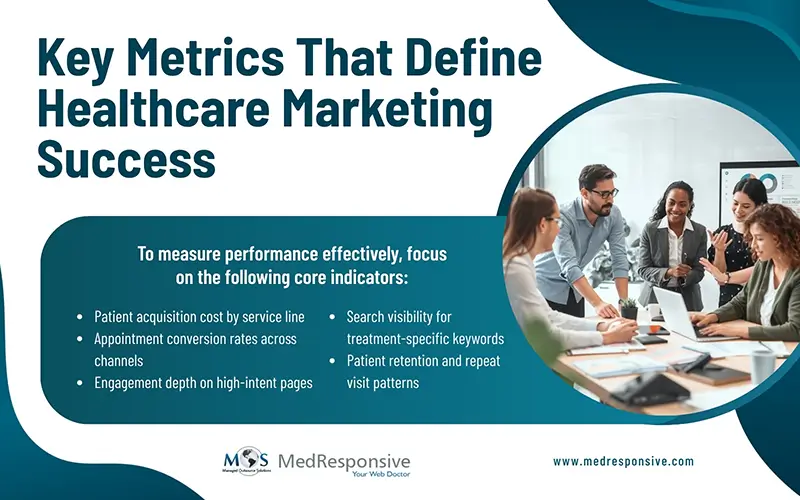
The Real Measure of Success in Healthcare Marketing
Success in healthcare marketing is not defined by isolated metrics or short-term gains. It is determined by how effectively marketing efforts contribute to patient acquisition, experience, and long-term engagement. Organizations that rely solely on surface-level indicators risk misinterpreting performance. Those that integrate acquisition, engagement, conversion, and retention metrics gain a clearer and more actionable understanding of results.
Partnering with a healthcare SEO agency ensures your practice ranks higher, attracts the right patients, and builds trust online. By combining analytics dashboards, SEO tracking tools, and compliance-ready reporting, these agencies deliver a clear view of marketing performance, helping healthcare organizations prove ROI, refine strategies, and sustain growth.
Powered by AI-driven systems and guided by strategic expertise, they enable providers to adopt a structured, insight-driven approach to measuring success. This positions healthcare organizations to strengthen patient trust, boost service utilization, and achieve sustainable growth with confidence.